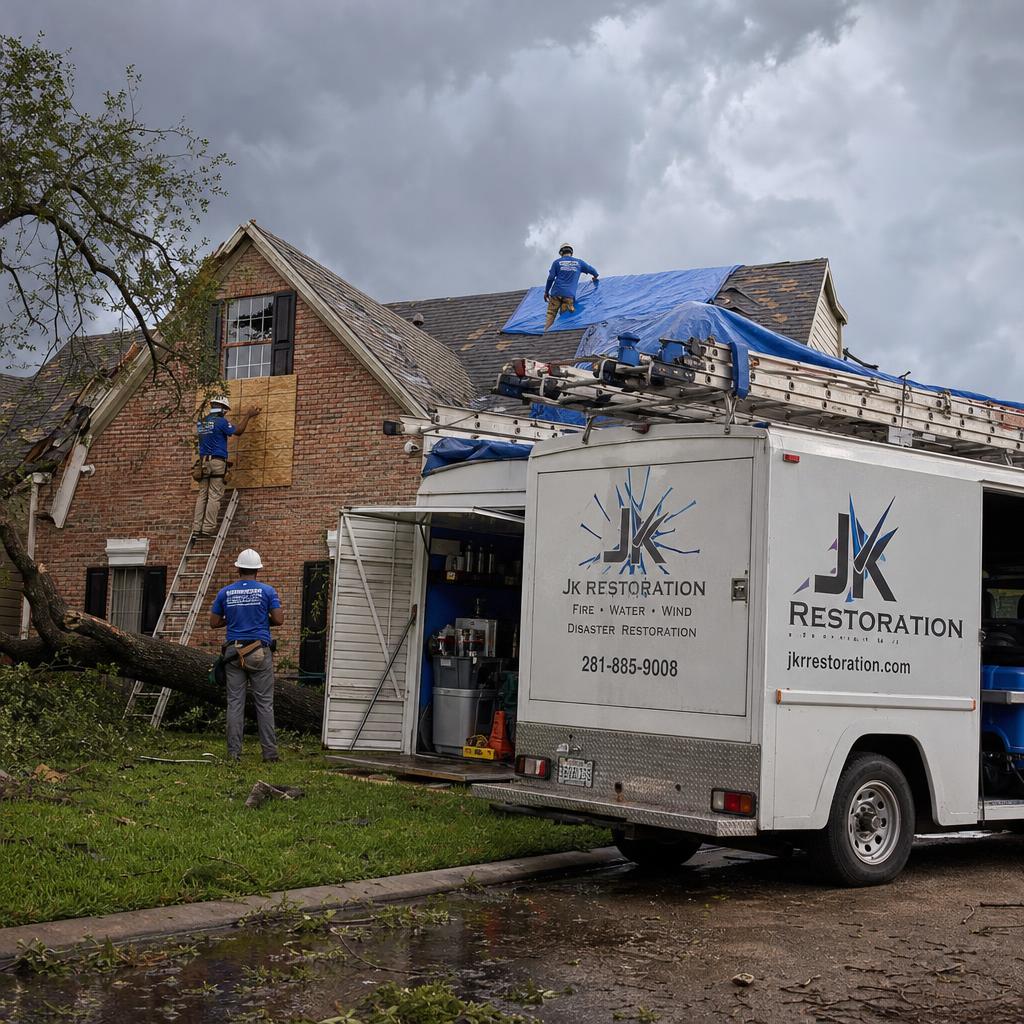
Immediate Mitigation Requires Expertise
From tropical storms to sudden downpours, Harris County floods fast. We handle emergency board-up, water removal, and full structural recovery so you can get back to normal.
Service Response Note
Storm-team crews scale up during active weather events.
What We Do
- Emergency tarping and board-up
- Flood water extraction and drying
- Structural and contents assessment
- Coordination with FEMA and insurance claims
Understanding Storm & Flood Damage
Harris County's flat terrain and dense network of bayous mean rainfall has nowhere fast to go. A few inches of rain in a short window can push Buffalo Bayou, Brays Bayou, and dozens of smaller waterways past capacity, and tropical systems moving in off the Gulf regularly bring both high wind and storm surge. Whether the damage came from a hurricane, a sudden downpour, or straight-line winds tearing off roofing material, storm damage rarely stays contained to one type of problem — wind damage and water intrusion usually arrive together.
Our storm response starts with securing the structure: emergency tarping over roof breaches, board-up for broken windows or doors, and stopping any active water intrusion before it spreads further. From there we move into full flood water extraction and structural drying, following the same rigorous process we use for any water event, and we conduct a contents assessment to determine what can be cleaned and restored versus what's a total loss. Because storm damage claims often involve both a homeowner's policy and, in some cases, FEMA assistance, we document everything thoroughly and coordinate directly with adjusters to keep your claim moving.
Named storms bring a specific complication beyond the physical damage: call volume across the entire region spikes at once, and restoration companies without real surge capacity end up putting homeowners on a waitlist during the exact moment speed matters most. We scale our storm-team staffing ahead of forecasted systems rather than reacting after landfall, and we prioritize dispatch based on active water intrusion and safety risk rather than strictly first-come, first-served. If floodwater from a named storm affected a wide swath of your neighborhood, expect us to ask a few extra triage questions on the call — that's so we can sequence crews efficiently across everyone who needs help, not a sign you're being deprioritized.
Storm Recovery for Gulf Coast Properties
Storm damage rarely fits into one category. A hurricane or severe thunderstorm can combine roof openings, broken windows, wind-driven rain, rising floodwater, power loss, and contents damage in a single call. Residential owners may need immediate extraction and temporary protection, while commercial property managers may be coordinating multiple suites, tenants, vendors, and access restrictions at the same time. Our first assessment separates life-safety issues and active water intrusion from the restoration work that can follow.
We help organize the recovery sequence so the most damaging conditions are addressed first: secure the opening, remove bulk water, protect contents, and start drying before humidity and trapped moisture create secondary damage. Photos, moisture readings, and a room-by-room scope give your insurance carrier a usable record even when the property is difficult to access. During regional weather events, our dispatch team also asks about power, road access, and the current source of water so crews arrive with equipment that can actually be used safely.
As an IICRC-certified firm, we follow strict industry guidelines for all our procedures. Whether the damage is confined to a single room or has affected multiple floors, our technicians arrive equipped to handle the full scope of mitigation.
We document every step of the process. From the initial moisture mapping to the daily drying logs, we provide the comprehensive documentation required to verify the structure is dry and to support your insurance claim.