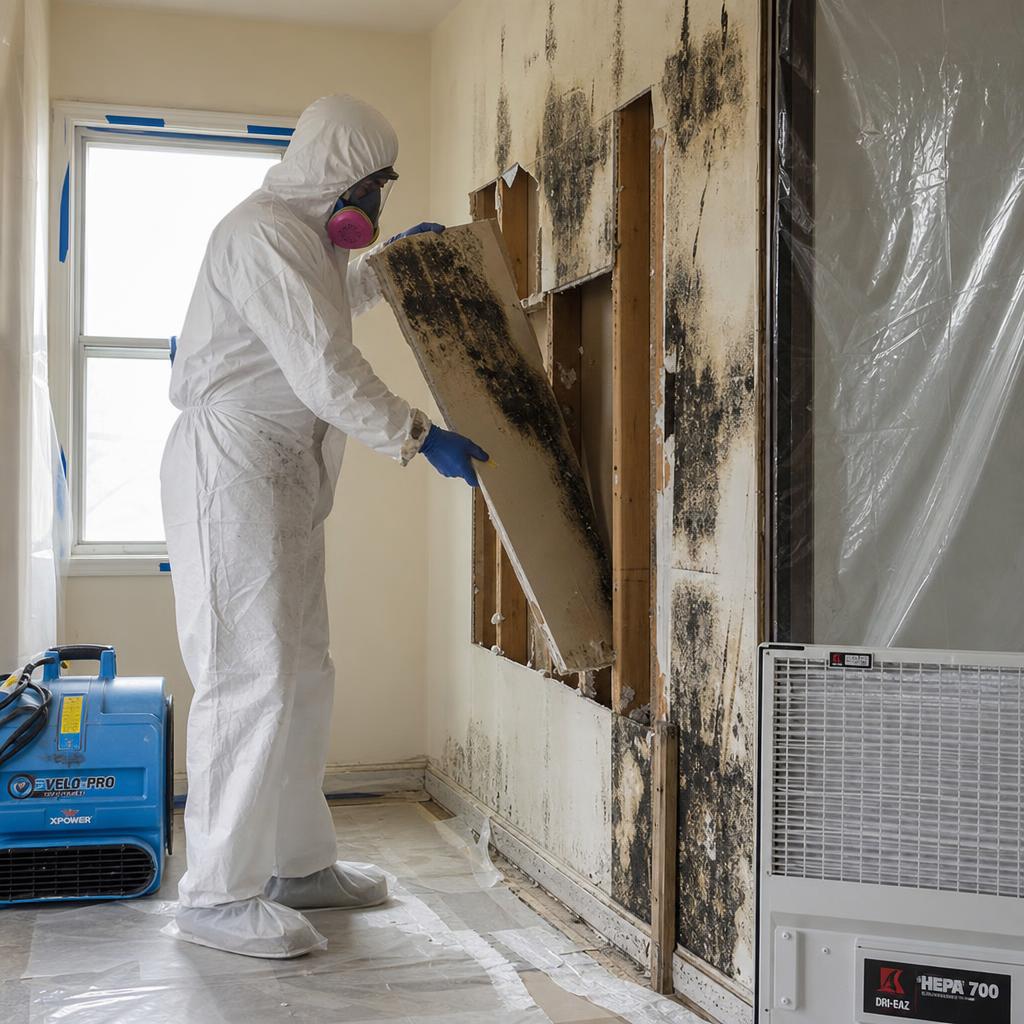
Immediate Mitigation Requires Expertise
Houston humidity means mold can take hold within 24-48 hours of a water event. We contain the affected area, remove and treat compromised materials, and verify the space is safe.
Service Response Note
Containment barriers set before any demolition begins.
What We Do
- Full containment with negative air pressure
- HEPA air scrubbing and filtration
- Safe removal and disposal of affected materials
- Post-remediation verification
Understanding Mold Remediation
Mold spores are present in almost every environment, but they need moisture to become an active colony, and Houston's Gulf Coast humidity supplies that moisture year-round. After any water intrusion — a slow slab leak, a roof breach, or flooding from a storm — mold can begin colonizing damp drywall, insulation, and wood framing in as little as 24 to 48 hours. Left unaddressed, it spreads behind walls and through HVAC systems, which is why we treat mold as a time-sensitive problem rather than a cosmetic one.
We start every job by isolating the affected area with physical containment barriers and negative air pressure machines, so spores can't migrate into unaffected rooms while we work. HEPA air scrubbers run continuously to filter airborne spores out of the contained space. Our technicians then remove and safely bag compromised porous materials — drywall, insulation, and carpet that can't be salvaged — while treating salvageable structural surfaces with EPA-registered antimicrobial agents. Once remediation is complete, we perform a post-remediation visual and moisture verification before removing containment, so you're not left wondering whether the job actually solved the problem.
Mold jobs in Houston often start in places homeowners never think to check — behind baseboards in a room with an old slab leak, inside HVAC supply boots that stayed damp after a summer humidity spike, or in attic decking after a slow roof leak went unnoticed for months. Because our crews handle both water mitigation and mold remediation, we're often the ones who catch a colony forming during an unrelated extraction or drying job, which lets us contain it before it spreads through the rest of the structure. We also pay close attention to HVAC systems specifically, since a contaminated air handler can quietly reseed a room that was already remediated if it isn't addressed as part of the same job.
Mold Remediation for Occupied and Commercial Spaces
Mold remediation has to protect the people who use the building as well as the building itself. In a home, that may mean isolating a bedroom, nursery, or HVAC closet while the family uses the rest of the property. In an office, clinic, school, or multifamily building, the work also has to account for shared corridors, neighboring tenants, ventilation pathways, and a reopening schedule. We establish containment before disturbing affected materials and keep the work area separated from clean spaces.
The scope is based on the moisture source, the materials involved, and how far contamination may have traveled. Porous drywall and insulation often cannot be safely restored, while framing and hard surfaces may be cleaned and treated when their condition allows. We pair removal with moisture correction, HEPA filtration, and post-remediation verification so the same leak or humidity problem does not restart the growth. When independent testing is needed, we can coordinate access for an industrial hygienist and provide the project documentation they need.
As an IICRC-certified firm, we follow strict industry guidelines for all our procedures. Whether the damage is confined to a single room or has affected multiple floors, our technicians arrive equipped to handle the full scope of mitigation.
We document every step of the process. From the initial moisture mapping to the daily drying logs, we provide the comprehensive documentation required to verify the structure is dry and to support your insurance claim.